With more than 98% of expected call report filings submitted, this update provides a first look at the year-end trends across the credit union industry. The analysis reflects data based on 4,308 call reports filed as of December 31, following the close of the on-time reporting window, compared to 4,420 filings last quarter. Key themes for the quarter include renewed balance-sheet growth, improving earnings and emerging credit quality pressures.
CU balance sheets
After moderating mid-year, asset and deposit growth accelerated in the fourth quarter. For full-year 2025, assets grew 6.32%, driven primarily by total share growth of 6.39%. At the same time, credit unions continued to reduce reliance on external funding sources (i.e., borrowings and non-member deposits). These sources accounted for 4.93% of shares and liabilities at year-end, down from 5.22% last quarter and well below levels recorded throughout most of 2023 and 2024. 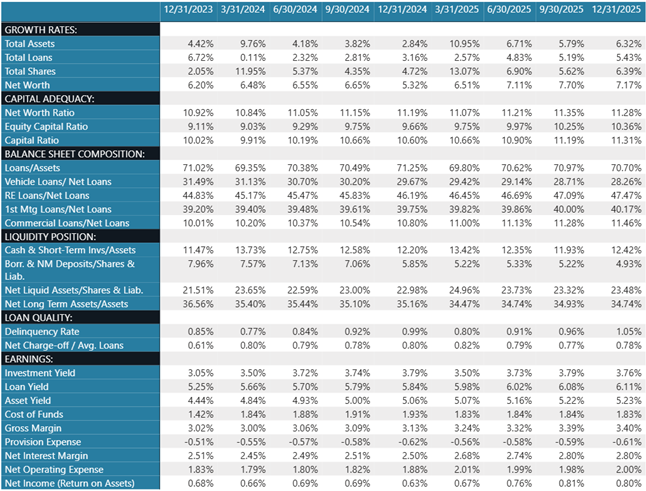
Loan growth rate strengthened steadily throughout the year, increasing from an annualized pace of 2.57% in the first quarter to 5.43% by year-end. Despite the acceleration, loan growth still trailed share growth by 96 basis points for the year. Growth was led by second-lien loans, which rose 15.2% and commercial real estate, up 11.0%. In contrast, new vehicles loans declined 2.6%, while “other” loans fell 1.5%. Used vehicle lending, historically viewed as a core credit union product, showed minimal growth of just 0.5%. Net worth increased 7.17% in 2025, leaving the industry with a solid net worth ratio of 11.28% at year-end.
Liquidity
Liquidity conditions remain strong. As external funding usage declined, cash and short-term holdings remain elevated. At year-end, cash and short-term investments represent 12.42% of assets, up from 11.93% on September 30. While this ratio is down from the March 31 peak of 13.42%, it continues to reflect ample liquidity across the industry.
Looking ahead, elevated short-term balances may place modest pressure on earnings as the Federal Open Market Committee (FOMC) has reduced the federal funds target rate and markets anticipate potential future cuts in 2026. However, loan growth remains below deposit growth, helping to alleviate near-term liquidity concerns.
Loan quality
Credit performance showed signs of softening in 2025. The 60-plus-day delinquency rate declined early in the year to 0.80%, then increased each subsequent quarter. At year-end, delinquency reached 1.05%, exceeding the prior year-end peak of 0.99%. Net charge-offs, however, remain stable. Charge off rates stayed within a narrow five basis point range throughout the year and finished 2025 at 0.78%, suggesting that while delinquencies are rising, loss severity has not materially worsened.
Earnings
Earnings improved in 2025 compared to the prior year. The industry return on assets (ROA) reached 0.80% for the year, just one basis point below the third-quarter peak of 0.81% and well above the 0.63% reported for 2024. Asset yield increased steadily every quarter, despite a modest decline in the fourth quarter investment yield as cash rate declined. Loan yields rose 27 basis points in 2025. Funding costs remained tightly controlled, holding steady within one basis point each quarter and ending the year at 1.83%, down 10 basis points from 2024. Provision expense declined slightly to 0.61%, while net operating expense increased 12 basis points to 2.00%.
Turning insight into strategy
Catalyst ALM experts are helping credit unions interpret these trends and position themselves for a shifting rate environment.
Contact our ALM team to turn today’s data into tomorrow’s strategy.