With interest rate volatility and uncertainty remaining a key variable in today’s Asset/Liability Management (ALM) environment, credit unions continue to actively use derivatives to manage their interest rate risk (IRR). As of December 31, 2025, natural person credit unions had $42.2 billion notional outstanding in swaps and $4.9 billion notional outstanding in options (caps and floors).
While there are multiple hedging strategies credit unions can implement, most of the swaps outstanding are pay fixed/receive variable, which means credit unions are hedging the fair value of their fixed-rate assets, most likely fixed-rate mortgages.
Based on the high concentration of swaps, this article will explore what a swap is and how it helps manage the fair value change of a fixed-rate mortgage loan portfolio.
What does an interest rate swap entail?
- A financial contract in which two parties agree to exchange two sets of interest payments (fixed for floating or floating for fixed) for a set time frame.
- There is no exchange of principle – interest payments are based on a predetermined notional principal amount and are netted.
- No upfront premiums are paid to the counterparty.
Example: Hedging a fixed-rate mortgage loan portfolio
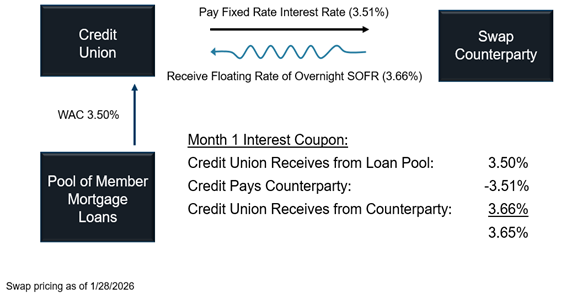
Credit union A has a pool of real estate loans with a weighted average coupon of 3.50%. This low-coupon pool is exposed to a decline in market value, assuming rising interest rate scenarios. With swap rates having declined over the last year, the credit union evaluates the opportunity to reduce the interest rate risk embedded in the pool of loans by adding a five year pay fixed/receive variable rate interest rate swap. The variable rate received from the counterparty is based on Overnight SOFR.
Financial impact
Depending on the notional size of the swap relative to the loan pool, the changes to the income stream and valuations will vary under shocked rate scenarios. With the swap, the coupon formula for the hedged portion of the pool changes from 3.50% to:
- 3.50% - 3.51%+3.66% (SOFR) = 3.65%
If SOFR increases by 100 bps, the interest earned is:
- 3.50% - 3.51% + 4.66% (SOFR) = 4.65%
If SOFR decreases by 100 bps, the interest earned is:
- 3.50% - 3.51% + 2.66% (SOFR) = 2.65%
In addition to changing the income stream, the pay fixed/receive variable rate swap provides a better effective duration (price sensitivity) of the pool to rising interest rates. For that reason, credit unions have utilized pay fixed/receive variable rate swaps to help mitigate IRR with respect to fixed-rate mortgage loans.
Other strategies to consider
While pay-fixed rate swaps remain a viable hedging option for credit unions that have a sizeable and/or growing mortgage portfolio, there are other hedging strategies to consider in this interest rate environment, including:
- Receive-fixed swaps – adding receive-fixed rate swaps can protect variable-rate loans and investment if the Fed cuts rates more aggressively.
- Interest rate floors – adding interest rate floors can help protect variable-rate loans or investments if the Fed cuts rates more aggressively.
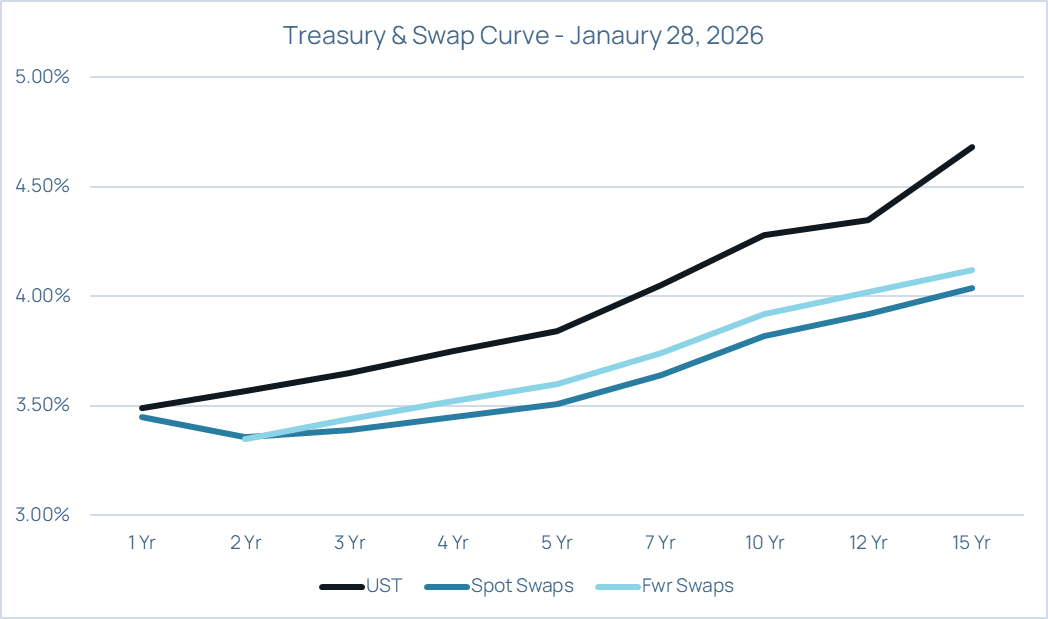
- Pay-fixed swaps – adding spot-starting and forward-starting pay-fixed rate swaps can protect the market value of legacy fixed-rate mortgage portfolios.
How Catalyst supports credit union hedging programs
For credit unions looking to start or expand their hedging program, Catalyst has a comprehensive derivatives program designed to be a strategic partner. Key services include:
- Training and education for management, ALCO and the Board
- Development of derivative policies and procedures
- Specific hedging strategy analysis and trade recommendations
- Assistance with hedge pricing and trade execution
- Quarterly ALCO and board reporting, plus annual post-trade reviews
- Counterparty agreement (ISDA Master and CSA) support
- Daily valuation and collateral management
- Annual counterparty credit analysis
Interested in learning more about how derivatives can support your balance sheet strategy?
Join us for Catalyst’s third annual Derivatives Symposium on April 28 from 1 – 4:00 p.m. CT to gain insights into today’s interest rate environment, hedging strategy considerations and best practice for building a successful derivatives program.
Register today to reserve your spot, it’s complimentary and open to credit union professionals.